








Are you a young researcher working on nuclear verification, disarmament, or related fields? Then take a look at our New Perspectives Call!
NEW PUBLICATIONS AVAILABLE
in our Blog Series
“New Perspectives on Nuclear Verification“


VeSPoTec Banner

New Perspectives on Nuclear Verification
Friedens- und Konfliktforschung NRW
VeSPoTec is a project by:


The research consortium VeSPoTec – Verification in a complex and unpredictable world: social, political and technical processes is a cooperation between the RWTH Aachen University, the Forschungszentrum Jülich, the TU Darmstadt and the University of Duisburg-Essen.
Associated partners include the University of Vienna and the Vienna Center for Disarmament and Non-Proliferation (VCDNP).
VeSPoTec is funded by the German Federal Ministry of Research, Technology and Space (BMFTR, formerly BMBF).
What is Verification?
Verification is the process of gathering and analysing information to assess whether other parties comply with their commitments. This way, it allows to build confidence and ensures an effective implementation of international agreements.
Our Mission
VeSPoTec’s mission is to build bridges between the natural and social sciences to strengthen and advance the knowledge on verification in the context of peace and conflict research.

Why an interdisciplinary approach?
Given the complexity and dynamics of the challenge of nuclear verification, the interaction of different disciplinary perspectives is indispensable for understanding the phenomenon and for developing sustainable and applicable solutions. The specificity of the project therefore lies in the synergy of inter- and transdisciplinary work among the partners with their complementary foci on natural, social, political and cultural sciences as well as practice.
Blog
By MD Arifur Rahman. Tritium is a radioactive material with a half-life span of just 12.3 years, which is usually used as a boosting element in nuclear weapons, allowing relatively smaller bombs to release more than 10,000 tons of TNT energy without requiring a full thermonuclear weapon. Tritium quickly breaks down, so countries
By Kashaf Sohail. When we talk about “verification” in nuclear politics, most people picture inspectors counting warheads, satellites tracking fissile materials, or monitoring treaty compliance. But verification is more than a technical checklist. At its core, it builds the shared knowledge required for stability, allowing
By Natalia Luers. ABACC, the Brazilian-Argentine Agency for Accounting and Control of Nuclear Materials, was created after Argentina and Brazil shifted from nuclear rivalry to cooperation, turning their foreign-policy convergence into a verification-based mechanism that reinforced Latin America's peace. In 1991, after both countries
For previous Blog posts, please click here.
Team
Principal Investigators
Prof. Dr. Malte Göttsche
Coordinator
Science for Nuclear Diplomacy
Peace Research Institute Frankfurt
goettsche@prif.org
Prof. Dr. Stefan Böschen
Human Technology Center
RWTH Aachen
stefan.boeschen@humtec.rwth-aachen.de
Dr. Irmgard Niemeyer
Nuclear Waste Management (IEK-6)
Forschungszentrum Jülich
i.niemeyer@fz-juelich.de
Prof. Dr. Ralph Rotte
International Relations
RWTH Aachen
rotte@ipw.rwth-aachen.de
Dr. Carmen Wunderlich
Institute of Political Science
University Duisburg-Essen
carmen.wunderlich@uni-due.de
Managing Director
Dr. Ana de la Varga
Nuclear Verification and Disarmament
RWTH Aachen
delavarga@nvd.rwth-aachen.de
Administrative Assistant
Melanie Baumann
Human Technology Center
RWTH Aachen
melanie.baumann@humtec.rwth-aachen.de
Scientific Staff
Dr. Laura Mertes
Science for Nuclear Policy
TU Darmstadt
Dr. Ing. Neslihan Yanikömer
Institute of Fusion Energy and Nuclear Waste Management (IFN)
Forschungszentrum Jülich n.yanikoemer@fz-juelich.de
Dr. Kim Westerich-Fellner
Institute of Fusion Energy and Nuclear Waste Management (IFN)
Forschungszentrum Jülich
k.westerich-fellner@fz-juelich.de
Dr. Robin E. Möser
Science for Nuclear Diplomacy
Peace Research Institute Frankfurt (PRIF)
TU Darmstadt
robin.moeser@prif.org
Student Assistants
Mette Marie Elisabeth Wohlfahrt, B.A.
Institute of Political Science
University Duisburg-Essen
mette.wohlfahrt@stud.uni-due.de
Josias Bruderer, B.A.
Human Technology Center
RWTH Aachen
josias.bruderer@humtec.rwth-aachen.de
Further Partners
See our former team members here.
Advisory Board
Dr. Hassan Elbahtimy
Centre for Science and Security Studies, King’s College
Dr. Angela Kane
Vienna Center for Disarmament and Non-Proliferation (VCDNP)
Dr. Marco Marzo
Brazilian-Argentine Agency for Accounting and Control of Nuclear Materials (ABACC)
Dr. Pavel Podvig
UN Institute for Disarmament Research
Laura Rockwood
Vienna Center for Disarmament and Non-proliferation (VCDNP)
Amy Woolf
Royal United Services Institute
Contact
Feel free to contact us at vespotec@rwth-aachen.de for questions and further information about the project.
Call for Papers: Panel “Knowing in a Nuclear Weapons World”
Open Conference of the ‘International Relations’ Section of the German Political Science Association (DVPW) — September 2026, Würzburg
VeSPoTec seeks to organize a panel at the upcoming Open Conference of the International Relations Section of the German Political Science Association (DVPW), which will take place in Würzburg from September 21 to 23, 2026. The aim of the panel is to bring together different perspectives on the epistemic processes through which nuclear power becomes politically effective—and to show that “knowing” itself represents a form of nuclear order formation.
We’re looking for theoretical and empirical contributions that understand knowledge production processes as a central component of nuclear (dis)order formation and examine how knowledge about nuclear policy is produced, legitimized, and challenged—and who is involved in this process. Please find more information in the full call for paper attached below.
Call for Paper (in German)
Call for Papers: “Knowing in a Nuclear Weapons World”
Panel im Rahmen der Offenen Tagung der Sektion Internationale Beziehungen der DVPW, 21.–23. September 2026, Würzburg
In einer Welt, in der Nuklearwaffen wieder an Relevanz gewonnen haben und zunehmend politische Ordnungs- und Sicherheitsvorstellungen sowie technologische Zukünfte prägen, stellt sich die Frage, wie Wissen über Nuklearwaffen entsteht, zirkuliert und politisch wirksam wird, mit neuer Dringlichkeit. Das geplante Panel „Knowing in a Nuclear Weapons World“ lädt Beiträge ein, die sich mit den vielfältigen Formen und Praktiken der Wissensproduktion rund um Nuklearwaffen befassen – sei es in politischen, wissenschaftlichen, medialen oder zivilgesellschaftlichen Kontexten. Im Mittelpunkt steht die Frage, wie Wissen über Nuklearwaffen entsteht, welche epistemischen Autoritäten es prägen und wie alternative Wissensformen sichtbar gemacht oder marginalisiert werden. Insbesondere soll auch das Verhältnis von Wissen und Macht im Feld der Nuklearpolitik kritisch ausgelotet werden.
Wir interessieren uns für theoretische wie empirische Beiträge, die Wissensproduktionsprozesse als zentralen Bestandteil nuklearer (Un-)Ordnungsbildung begreifen und untersuchen, wie Wissen über Nuklearpolitik hergestellt, legitimiert und herausgefordert wird – und wer daran beteiligt ist. Mögliche Themen umfassen:
- Kritische, feministische und post-/dekoloniale Zugänge zur Nuklearpolitik, die Praktiken der Wissensproduktion beleuchten
- Prozesse der Übersetzung, Geheimhaltung oder Zirkulation nuklearen Wissens in politischen und öffentlichen Arenen
- der Umgang mit Unwissen, Unsicherheit und Ambivalenz in nuklearen Entscheidungsprozessen
- öffentliche Meinung, Diskursformationen und mediale Narrative als Wissensorte des Nuklearen
- Arbeiten zu öffentlicher Meinung, Diskursen und Repräsentationen von Nuklearwaffen
- Beiträge aus den Science and Technology Studies (STS) zu Technologien, Expertentum und Unsicherheit in nuklearen Zusammenhängen
Ziel des Panels ist es, unterschiedliche Perspektiven auf jene epistemische Prozesse zu bündeln, durch die das Nukleare politisch wirksam wird – und sichtbar zu machen, dass “knowing” selbst eine Form nuklearer Ordnungsbildung darstellt.
Die Frist zur Einreichung der Panel ist bereits am 15. Februar 2026. Daher bitten wir bei Interesse um zeitnahe Einreichung von Abstracts (max. 200 Wörter), Titel des Beitrags (max. 50 Wörter) sowie institutionelle Anbindung und offzielle Emailadresse bis Mittwoch, 11. Februar 2026 an carmen.wunderlich@uni-due.de. Die individuellen Beiträge können in englischer oder deutscher Sprache eingereicht werden. Panels können entweder komplett in deutscher oder komplett in englischer Sprache eingereicht werden – wird sind für beides offen, bitte teil mögliche Präferenzen mit.
Workshop marks culmination of VeSPoTec’s first funding phase
04.02.2026, Vienna, Austria
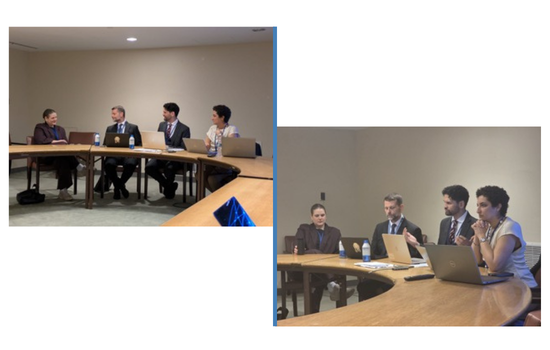
As geopolitical tensions rise and international treaties face unprecedented strain, the future of nuclear verification is uncertain. Against this backdrop, the Vienna Center for Disarmament and Non-Proliferation (VCDNP) and the research consortium “VeSPoTec – Verification in a complex and unpredictable world: social, political and technical processes” convened an expert-level workshop titled “Prospects for Nuclear Verification in Times of Uncertainty and Crisis.”
On 4 February 2026, experts from academia, research institutions, diplomatic missions and international organizations gathered in Vienna to discuss challenges facing nuclear verification today and explore potential future prospects. Leading experts in nuclear verification contributed to the workshop, including Noah Mayhew (VCDNP), Nikolai Sokov (VCDNP), Leonardo Bandarra (University Duisburg-Essen/VeSPoTec), and Carmen Wunderlich (University Duisburg-Essen/VeSPoTec). VCDNP Executive Director Elena K. Sokova and Malte Göttsche (CNTR/VeSPoTec) delivered opening remarks.
Participants addressed the implementation of International Atomic Energy Agency (IAEA) safeguards in crisis situations, in particular when nuclear facilities are caught in the crossfire of armed conflict or located in disaster zones. Considering the erosion of key arms control agreements that have historically been dominated by the Global North, participants further emphasized the need for adaptive strategies to sustain verification efforts as well as the role of the Global South in shaping verification practices as crucial for building a more inclusive and effective international framework.
Marking the end of VeSPoTec’s first funding phase, the workshop additionally looked to the future, namely its second funding phase (2026–2028). PRIF will participate in the second phase under the direction of Malte Göttsche. This next phase, titled “Knowing in the Nuclear Weapons World,” will delve into the political, epistemological, technical, and strategic processes shaping nuclear verification.

Containing nuclear risks, preserving the basis for future engagement: Prospects for the 11th Review Conference of the Nuclear Non-Proliferation Treaty (NPT)
10.12.2025, Berlin, Germany
Anticipating the 11th Review Conference of the Nuclear Non-Proliferation Treaty (NPT), VeSPoTec organized an event at the House of the Leibniz Association in Berlin to share information and facilitate discussion among political and scientific experts in the field.
The event brought together researchers, policymakers, and practitioners to discuss key challenges for the NPT amid sharpened geopolitical tensions and rapid technological developments. It aimed to explore how the present regime can remain effective after several review conferences ended without a consensual final document and against the backdrop of increasingly destabilizing factors.
Participants discussed the potential to generate new political momentum or to prevent further intensification of blockages and fragmentation. A central question raised was what defines a successful Review Conference and how to assess the outcomes of previous ones. Germany’s prospective role as a bridge-builder at the Review Conference was also explored.
Overall, the event provided a valuable forum for open dialogue with representatives from ministries, federal agencies, and think tanks to exchange insights on the NPT Review Conference and the new nuclear world order.
This aligns with VeSPoTec’s upcoming research, which focuses on knowledge infrastructures and verification processes beyond formal treaties.
The 11th “Review Conference of the Parties to the Treaty on the Non-Proliferation of Nuclear Weapons“ will be held from 27 April to 22 May 2026 in New York.
Knowing in the Nuclear Weapons World — Second Phase of VeSPoTec funded!
01.12.2025
We’re delighted to announce that the second phase of VeSPoTec under the title “Knowing in the Nuclear Weapons World” is funded. The research consortium continues as a cooperation between RWTH Aachen University (HumTec/SoTec, IPW), PRIF Leibniz-Institut für Friedens- und Konfliktforschung, Forschungszentrum Jülich (IFN-2, Nukleare Entsorgung), and University of Duisburg-Essen (IFP).
Stay tuned for upcoming news!
Carmen Wunderlich receives the 2025 Political Science Teaching Award
20.11.2025, Darmstadt, Germany
Congrats to our PI Carmen Wunderlich for receiving the Political Science Teaching Award 2025 for her seminar on nuclear disarmament, non-proliferation & global security! With her exceptional teaching approach, she is empowering students to critically engage with political developments.

For previous news, please click here.


Dr. Leonardo Bandarra
Andreas Dürholt, M.A.
René Geiser, M.A.
Linda Ostermann, M.A.