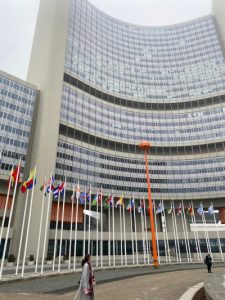
By Josias Bruderer, Linda Ostermann, Julian Schäfer, and Leonardo Bandarra. A treasure of uncountable worth lays in Vienna (Austria): the archives of IAEA. It documents the history of IAEA and its activities in promoting the use of peaceful uses of nuclear technology and safeguarding against diversion of nuclear materials. Apart from these fundamental responsibilities, the archives are essential for research on nuclear verification.
A group of VeSPoTec members took the chance to browse through the archives last February. What they found was insightful and intriguing, even some rare gems were found in the hundreds of files. Linda Ostermann is tracing how knowledge-producing infrastructures were negotiated in the IAEA’s policy-making bodies. For that, she was searching for documents that reconstruct the historical course of negotiations on safeguards implementation. The materials found in the archives are the ground of her research project and therefore indispensable.
Julian Schäfer visited the archives to gain a better understanding of how Member States support the IAEA’s safeguards infrastructure. The documents he found are key to contextualising the interviews that have already been conducted regarding how the complex coordination and cooperation is structured between the IAEA, States and R&D organisations.
Finally, Leonardo Bandarra took a deep dive into the role of regional organisations in cooperating safeguards implementation with the IAEA, and into the contributions of countries from the Global South (or Global Majority) in discussions at the Board of Governors. Both these under-research topics will be central in his research agenda for the upcoming VeSPoTec-Hub.
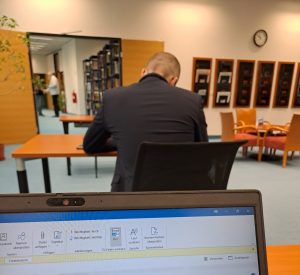
Thus experienced in working through and with archive data, the IAEA archives in Vienna are perceived as exceptional: The archivists have to balance the difficulty of providing transparent access to thousands of documents which contain lots of classified information. This declassification of relevant documents but also the security checks require preparation, which is reflected in the registration procedure required to visit the archive.
In short, visiting the IAEA archives in Vienna is definitely worth it. Our researchers were astonished by the vast number of documents accessible and, of course, they could only scratch at the potential of the archives, and it’s variety of records and media. We recommend other researchers to give this treasure trove a try!